


Railing is the most frequently failed element in residential deck inspections in Indiana, even though it often looks simple at first glance. The Indiana code for deck railing may seem straightforward, but the 2020 Indiana Residential Code treats railing as essential life safety infrastructure, with requirements that are more detailed than most homeowners expect.
Inspectors across the state consistently point to the same issue, railing failures happen not because homeowners are careless, but because the rules are easy to misunderstand and often vary by jurisdiction. What appears to be a cosmetic feature actually plays a critical role in safety, and the code reflects that with strict and specific standards.
This guide breaks down the Indiana code requirements for deck railings and handrails, highlights the most common mistakes homeowners make, and explains when bringing in a professional is not just a good idea but necessary.
What the Indiana Code for Deck Railing Actually Says
Indiana adopts the International Residential Code (IRC) with state-specific amendments. The governing sections for deck railing are primarily IRC R312 (guards) and IRC R311 (stairways and handrails), along with IRC R507 for deck construction generally. Local jurisdictions, including Indianapolis, Greenwood, Portage, Hamilton County, Vigo County, and others, may add additional requirements.
Guardrail height requirements
Any open-sided walking surface, such as a deck, balcony, or landing, that is more than 30 inches above the grade or floor below requires a guardrail. This requirement helps prevent falls from elevated surfaces.
To determine whether a guardrail is needed, the 30-inch threshold is measured at any point within 36 inches horizontally from the open edge. If the drop exceeds 30 inches anywhere within that zone, a guardrail must be installed.
When required, the minimum guardrail height is determined by the applicable building code. Under the IRC, guardrails must be at least 36 inches high, measured vertically from the walking surface to the top of the rail. However, for commercial or mixed-use buildings governed by the International Building Code (IBC), the minimum height increases to 42 inches. In such cases, the higher standard applies.
Baluster spacing and opening limits
Blauster spacing is where DIY decks fail most visibly, and most dangerously. Deck guardrail openings must not allow the passage of a 4-inch-diameter sphere anywhere from the walking surface to the top of the guardrail. At the stairs, the triangular openings formed by the tread, riser, and bottom guardrail must not allow passage of a 6-inch sphere.
The 4-inch rule exists specifically to prevent small children from squeezing through balusters and falling. Whereas the 6-inch rule at the stairs gives slightly more room because the geometry already constrains the opening shape.
A common mistake homeowners make is measuring center-to-center spacing between balusters rather than measuring the clear gap between them. For example, 4-inch center-to-center spacing on a 1.5-inch baluster leaves only a 2.5-inch gap, which is fine. But a 5.5-inch center-to-center spacing on a 1-inch baluster leaves a 4.5-inch gap, resulting in a code violation that can go unnoticed until it becomes a safety issue.
Railing strength requirements
Most DIY railings fail structurally, even when they look solid. Per IRC R312.1.1 and Table R301.5, guardrails must resist a 200-pound concentrated load applied in any direction at any point along the top of the rail, while the rail infill (balusters and intermediate rails) must resist a 50 psf load applied horizontally.
Simply put, someone has to be able to lean hard against the top rail, fall into the infill, or push laterally without the railing giving way. Surface-mounted post systems and undersized hardware routinely fail this test, not in theory, but in real-life situations, like when a 200-pound person leans on the rail at a backyard barbecue.
Stair railing (handrail) requirements
Stair handrails are governed by IRC R311.7.8 and are separated from guardrail requirements. A handrail is required on stairs with four or more risers and must be installed 34 to 38 inches high, measured vertically from the stair nosings. It must run continuously for the full length of the stair flight, which ends returning to a wall, post, or safety cap to prevent snagging.
Clearance is also critical, with a minimum of 1.5 inches required between the handrail and any wall or framing it’s mounted to. In terms of graspability, Type I handrails must either be circular with an outside diameter of 1¼ to 2 inches, or non-circular with a perimeter of 4 to 6¼ inches and a cross-section no greater than 2¼ inches. Type II handrails, which exceed a 6¼-inch perimeter, must have a graspable finger recess on both sides.
Standard 2×4 and 2×6 lumber, the default choice for countless DIY deck railings, does not meet these graspability requirements and remains one of the most cited violations in Indiana deck inspections.
Headroom and stair width (frequently overlooked)
Minimum stair width should be 36 inches clear at all points above handrail height. Where handrails are installed on both sides, the minimum clear width between them is 27 inches.
In addition, the minimum headroom must be 6 feet 8 inches, measured vertically from the sloped line of the stair nosings. This often becomes a real constraint when perimeter stairs turn at a landing and terminate beneath the deck, a common layout that can drop headroom below the minimum if not carefully planned.
The Most Common Indiana Railing Mistakes That Fail Inspection
Posts surface-mounted to the rim joist alone
The rim joist isn’t designed to transfer lateral loads without additional support. Bolting posts directly to the rim board without blocking behind it, hold-downs, or a through-bolt to the beam creates a railing that looks attached but fails the moment real force is applied. Inspectors know this detail, and they look for it.
The correct method is to anchor the posts through the rim into solid blocking, or to anchor them to the beam or a reinforced joist with through-bolts and washers on both the head and nut sides.
Posts notched at the bottom
Notching a 4×4 post at its base, which is a common surface-mounting technique, removes the outermost wood fibers, which carry the highest stress under bending load. The notched section becomes the weakest point in the entire railing system. Some big-box retailers even sell pre-notched posts; Indiana inspectors routinely reject them.
Wrong baluster spacing
Measuring center-to-center instead of gap-to-gap, or calculating spacing on a flat section without accounting for the angled geometry of stairs, produces violations that appear correct to the untrained eye. Always measure the clear opening, not the centerline distance.
Stair handrail attached to non-structural surfaces
Deck boards, fascia trim, and skirting are not structural framing. Screwing a handrail bracket into these surfaces provides minimal resistance to load. Handrail attachments must reach into, and be properly fastened to, structural framing or a dedicated post.
Using non-graspable rails
A 2×4 laid flat has a 3.5-inch-wide cross-section, well outside the 2¼-inch maximum for a graspable handrail. This violation appears on a significant percentage of Indiana deck inspections. The code exists because people grab rails when they’re falling, and if they can’t grip it, the rail doesn’t save them.
Wrong fasteners for pressure-treated lumber
Modern ACQ and CA pressure-treated lumber is significantly more corrosive to standard hardware than older CCA-treated wood. Electro-galvanized or black-oxide screws will visibly corrode within a few seasons in Indiana’s freeze-thaw climate. The code requires hot-dipped galvanized (ASTM A153, G185 coating), stainless steel (410 or 316), silicon bronze, or copper for any hardware in contact with treated lumber. Aluminum flashing is specifically prohibited.
Railing installed before inspections are complete
In Greenwood, Portage, Indianapolis, and most Indiana jurisdictions, footing and framing inspections are required before the project closes out. Installing finished railing before inspectors can verify blocking and post connections may force you to open up finished work, costing far more than sequencing correctly from the start.
When Indiana Homeowners Should Not DIY Deck Railings
DIY deck boards are usually manageable, but DIY railing carries a higher risk than most people expect. Consider hiring a professional if:
- The deck is more than 30 inches above grade, where the railing becomes critical fall protection, and failures can lead to serious injury
- The railing connects to a cantilevered section, where load distribution is more complex, and improper attachment can cause structural failure
- You’re repairing or adding to an older deck, where hidden rot or weakened fasteners can compromise new railing connections
- You are using a pre-packaged railing kit, which often prioritizes appearance and may not meet code load requirements without additional hardware
- The project includes stairs, which involve strict requirements for geometry, handrail continuity, and consistent riser heights
- You want to pass inspection the first time, avoiding delays, added costs, and rework
How a Professional Ensures Your Railing Meets Indiana Code
Building the complete load path
A properly installed railing doesn’t just look secure; every connection in the chain has to perform. That means through-bolts at post bases, blocking behind rim joists, tension ties, and washers under every bolt head and nut, all working together to move load from the top rail down through the post and into the footings. A professional builds every connection in that chain, through-bolts at post bases, blocking behind rim joists, tension ties, and washers under every bolt head and nut.
Hardware rated for Indiana’s climate
Indiana’s freeze-thaw cycling, seasonal moisture, and the chemistry of pressure-treated lumber demand G185 hot-dipped galvanized or stainless hardware. This isn’t an upgrade; it’s the minimum that holds up over a 20-year deck lifespan.
Stair railings built to exact geometry
Legal stair construction requires consistent risers (max 8¼ inches, max 3/8-inch variance across the flight), consistent tread depth (minimum 9 inches), proper nosing projection (¾ inch to 1¼ inch), and a handrail running continuously from above the top riser to above the bottom riser with proper returns. This geometry must be laid out before the first stringer is cut.
Knowledge of local amendments
The 2020 Indiana Residential Code sets the baseline, but local jurisdictions build on it with their own requirements. In the City of Portage (Lake County), frost depth is set at 36 inches, and licensed contractors are required. Permit applications must include detailed plans, including post connections, guard heights, and stair rise/run dimensions.
The City of Greenwood (Johnson County) uses a 30-inch frost depth, but imposes stricter structural requirements. For example, posts supporting a story above grade require significantly larger footings, such as 6×6 posts needing a 4’×4’×16″ footing, and composite decking must follow both code and manufacturer specs.
In Indianapolis / Marion County, rental properties face regular safety inspections, where missing, loose, or damaged handrails trigger citations. Properties in historic districts may also be subject to additional requirements enforced by the Indianapolis Historic Preservation Commission (IHPC).
Other counties, including Hamilton, Hendricks, Boone, and Vigo, often interpret IRC provisions such as R507 and R312 differently, particularly regarding post-attachment methods and ledger connection requirements.
Code-Compliant Railing Options for Indiana Homes
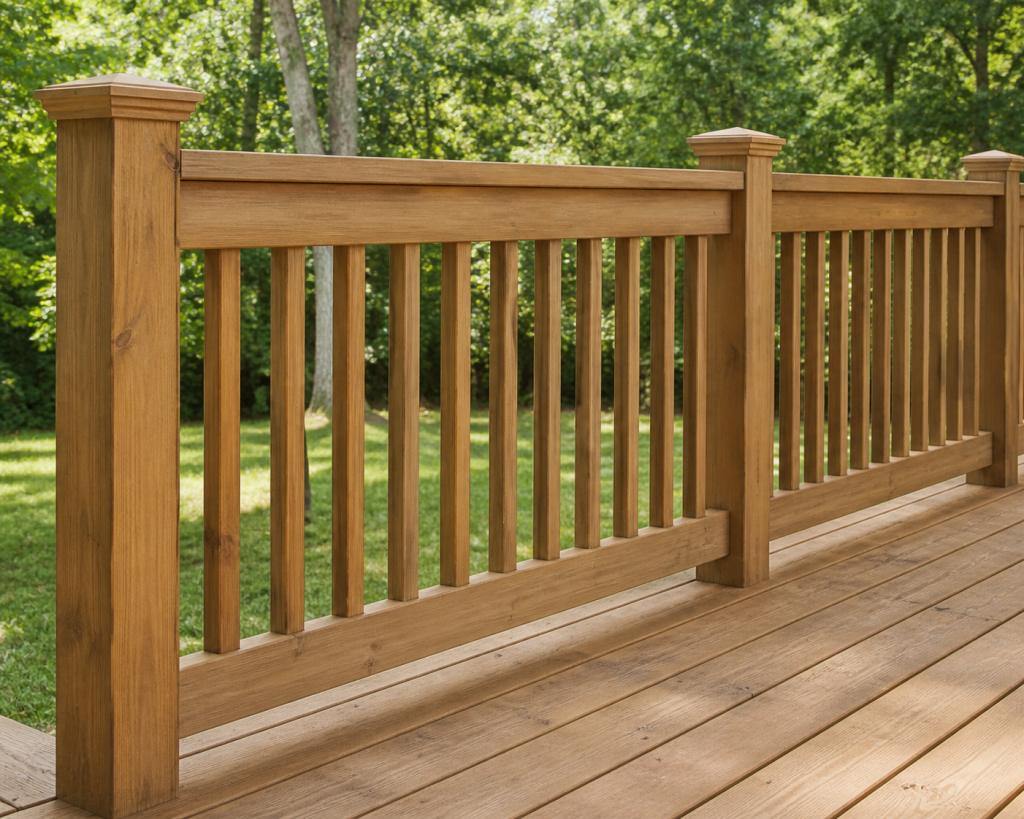
Wood railing is the most common and most field-adjustable, making it the default choice for many decks. However, only pressure-treated or naturally durable species should be used outdoors, and standard 2×4 top rails don’t qualify as handrails; a graspable profile is required on stairs.
For a lower-maintenance alternative, aluminum railing offers corrosion resistance while still meeting the same IRC R312 load requirements as wood. Because these systems are engineered, post-anchoring must follow the manufacturer’s specifications.
Similarly, composite railing systems such as Trex, TimberTech, Fiberon, and others must comply with both the IRC and the manufacturer’s requirements. Their post spacing and span differ from wood, and local jurisdictions like Greenwood explicitly require compliance with both.
More specialized options require additional care. Cable railing must be engineered to withstand cumulative tension while still meeting the 200-pound top-rail load and 4-inch sphere spacing rule. Glass railing, on the other hand, requires tempered or laminated safety glass (typically at least ½-inch thick for frameless systems), with connections designed to meet the 200-pound load requirement. Because approval can vary, it’s best to confirm with the local building department whether glass systems are approved.
Conclusion
Indiana code for deck railing sets the minimum threshold between a safe outdoor space and a serious liability because falls from decks cause real injuries, and railings that look solid can fail when people need them most.
The fundamentals are straightforward – guardrails must be at least 36 inches high above 30 inches, and balusters must block a 4-inch sphere. The railing system must withstand 200 pounds in any direction, have graspable handrails on stairways with four or more risers, and use corrosion-resistant hardware throughout. Layer on jurisdiction-specific requirements in Portage, Greenwood, Indianapolis, and surrounding counties, and it’s clear why railing is the most-failed element on Indiana deck inspections.