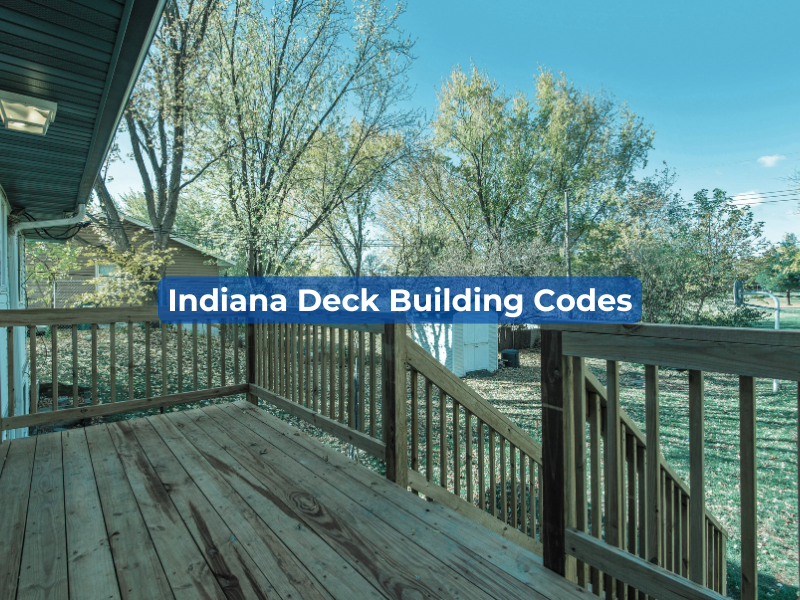
Building a deck in Indiana is more than just laying down boards and adding railings. With the U.S. decks market valued at $14.54 billion in 2024 and projected to reach $24.57 billion by 2033, the demand for high-quality, aesthetically pleasing outdoor spaces is rapidly increasing. This growth reflects homeowners’ and designers’ growing emphasis on building beauty, functionality, and safety.
Following the proper Indiana deck building codes is essential not only for legal compliance but also for ensuring your deck is safe, durable, and built to last. Whether you’re a homeowner planning your dream outdoor space or a contractor managing a client project, understanding Indiana’s deck regulations ensures every deck meets both local and state standards, while keeping up with the rising trend of modern, high-quality outdoor living spaces.
Understanding Indiana Deck Building Codes
Indiana deck building codes are based on the 2020 Indiana Residential Code, which incorporates the 2018 International Residential Code with Indiana-specific amendments. These codes ensure that all decks are safe, durable, and compliant with state and local regulations. Key elements covered under the Indiana deck building codes include:
- Materials and Lumber Requirements – grade, treatment, and species suitability
- Fasteners and Connectors – corrosion resistance and ASTM standards
- Deck Footings and Posts – frost depth, tributary area calculations, and anchoring
- Deck Framing – joist spans, girder sizing, and ledger attachment
- Stairs, Ramps, and Guardrails – dimensions, handrails, and safety openings
By following these regulations, both homeowners and contractors can ensure a structurally sound deck that meets all Indiana safety requirements.

General Deck Construction Requirements
Building a deck in Indiana requires careful attention to both safety and compliance with the Residential Building Code. With 6,746 Deck & Patio Construction businesses in the U.S. as of 2024, highlights how competitive and precise the industry is. Adhering to these standards ensures your deck is durable, structurally sound, and safe for all users, while keeping your project aligned with professional industry practices.
Lumber
Deck lumber must be No. 2 grade or better, preservative-treated or naturally durable. All wood in contact with the ground must carry a label indicating it is rated for ground contact. The most commonly available species in Indiana is Spruce-Pine-Fir, though Southern Pine is also used for projects requiring higher strength. Choosing the correct wood type not only ensures compliance but also protects your deck from decay, insect damage, and weathering.
Fasteners
Fasteners play a critical role in deck safety. Nails, bolts, screws, and metal connectors must meet ASTM standards and be corrosion-resistant. Approved materials include hot-dipped galvanized steel or stainless steel. Bolts and lags should follow specified diameters and spacing per the Residential Code, while all connectors should be made from the same corrosion-resistant material. Proper fasteners prevent structural failure, especially in Indiana’s varying climate conditions.
Composite Decking
When installing composite decking and railings, you must follow both the Residential Code and the manufacturer’s installation guidelines. Composite materials behave differently than traditional wood, so proper attachment methods, spacing, and fastening are essential to prevent warping, sagging, or premature wear.
Heavy Loads
Decks designed to support hot tubs, pools, or spas are considered high-load structures. These require designs by a licensed design professional or engineer. The additional weight places significant stress on joists, beams, and posts, making standard prescriptive designs insufficient. Engineering ensures your deck can safely support concentrated loads without compromising long-term durability.
Deck Framing
Framing provides the structural backbone of a deck. A well-designed framing plan includes the band board, joists, girders, and posts, arranged for proper support. Decks in Indiana can be:
- Self-supporting (with or without a cantilever)
- Ledger-attached to the house (with or without a cantilever)
The joist span depends on wood species and spacing. Spruce-Pine-Fir is commonly available in Indiana, while Southern Pine may need to be special-ordered.
Typical Deck Joist Spans for Common Lumber Species
| Lumber Species | Joist Size (in) | Spacing (in) | Max Span (ft) |
| Spruce-Pine-Fir | 2×6 | 16 | 9’0” |
| Spruce-Pine-Fir | 2×8 | 16 | 11’6” |
| Southern Pine | 2×6 | 16 | 10’0” |
| Southern Pine | 2×8 | 16 | 12’0” |
Decks attached to a house must have properly flashed ledger boards to prevent water damage. Special solutions are required when attaching to masonry veneer or cantilevered floor systems. All beam-to-post connections should use thru-bolts or approved metal connectors.
Deck Footings
Footings play a critical role in transferring the deck’s weight to the ground and preventing settling or structural failure. In Greenwood, Indiana, all footings must extend to frost depth, which is a minimum of 30 inches below grade, to prevent movement caused by soil freezing and thawing.
The size of each footing is determined by the tributary area, which calculates the portion of deck load supported by each post. Elevated decks carry higher point loads, so post footings for these structures must be larger than for decks closer to ground level. For self-supporting decks at grade, footings can be smaller, but posts must always be securely anchored to resist uplift from wind or uneven weight distribution.
Minimum Deck Footing Sizes
| Post Size | Minimum Footer Dimensions (W x L x D) |
| 4×4 | 2’-0” x 2’-0” x 8” |
| 6×6 | 4’-0” x 4’-0” x 16” |
| 8×8 | 4’-3” x 4’-3” x 17” |
By following these standards, your deck will have a stable foundation, ensuring long-term safety and structural integrity.
Deck Stairs
Deck stairs in Indiana must meet strict safety and dimensional standards to ensure safe and comfortable use. As part of the Indiana deck building codes, below are the key requirements:
| Feature | Requirement |
| Stair Width | Minimum 36” (handrail on one side), 27” (handrails on both sides) |
| Tread Depth | Minimum 9” |
| Riser Height | Maximum 8¼” |
| Stair Nosing | ¾” – 1¼” |
| Variation | Maximum 3/8” difference between tallest and shortest risers or treads |
| Landing Size | Minimum 36” x 36” and matching stair width |
| Handrails | Required for stairs with 4+ risers; mounted 34–38” above stair nosing; continuous grip along run |
When installing stairs with composite decking materials, follow both the Residential Code and the manufacturer’s installation guidelines to maintain durability and warranty coverage.
Adhering to these standards ensures your deck stairs are safe, code-compliant, and comfortable, providing a professional and reliable finish for your outdoor space.
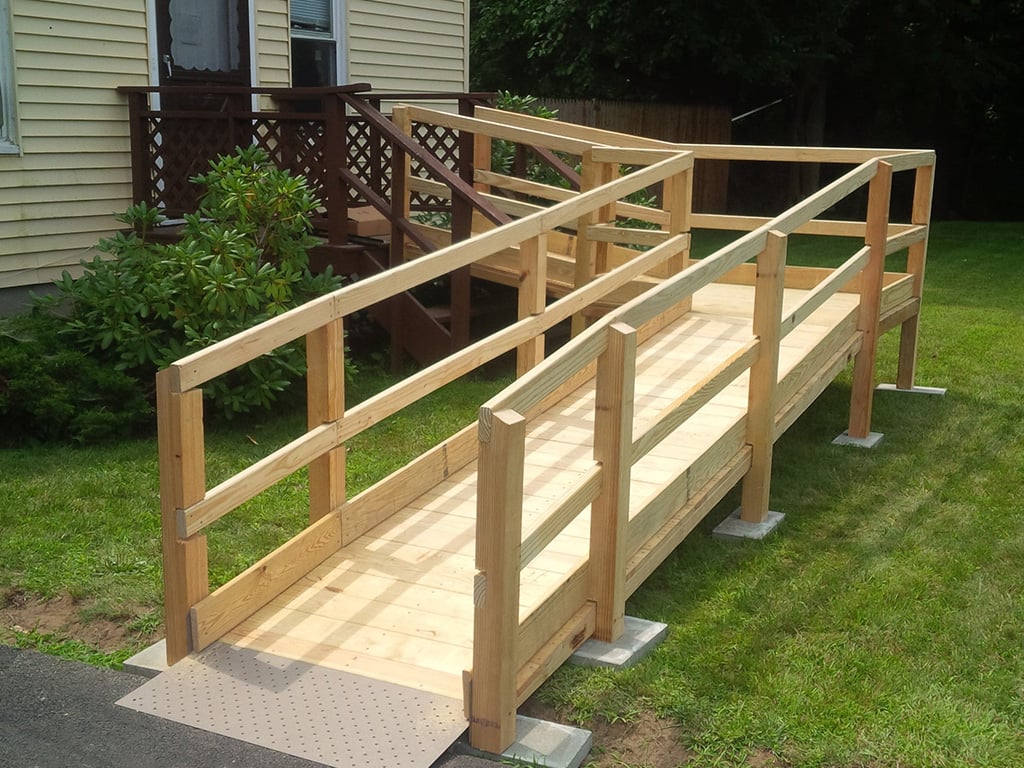
Deck Ramps
Deck ramps must be designed for safe accessibility while adhering to Indiana code requirements. The key standards are summarized below following the Indiana deck building codes:
| Feature | Requirement |
| Slope | Maximum 1:12 (rise:run). Where technically infeasible, max 1:8 slope. |
| Landing Size | Minimum 36” x 36” at top and bottom; must match ramp width |
| Handrails | Required on ramps; mounted 34–38” above ramp surface; continuous along the run |
| Attachment | Ramps must be securely fastened to deck framing to resist load forces |
| Composite Materials | Install per Residential Code and manufacturer’s specifications |
Following these standards ensures that deck ramps are safe, accessible, and code-compliant, providing smooth transitions for all users, including those with mobility challenges.
Deck Guardrails
Guardrails are a critical safety feature for decks, especially when the deck surface is elevated. In Indiana, decks more than 30 inches above grade must have guardrails to prevent falls and ensure compliance with the Residential Building Code. Proper installation and secure attachment are essential to withstand lateral forces and daily use.
| Feature | Requirement |
| Height | Minimum 36” above deck surface |
| Spacing | Horizontal or vertical spindles/rails must be less than 4” apart |
| Stair Triangular Openings | Openings formed by tread, riser, and bottom guardrail must be smaller than a 6” sphere |
| Post Anchoring | Posts must be firmly anchored to the deck frame to resist 200 lb. lateral force |
| Fasteners for Wood Posts | Minimum 2-½” diameter thru-bolts with washers, 2” from top and bottom of frame |
| Clearance | Minimum 1½” gap between handrail and framing; handrail cannot project more than 4½” from the side of the stair or deck |
Correctly installed guardrails help protect family, guests, and pets from falls. Always ensure that materials, fasteners, and post connections meet code standards, and follow any additional manufacturer recommendations for composite or metal railing systems.
Proper guardrails not only comply with Indiana deck building codes but also enhance the visual appeal and overall value of your deck.
Key Material and Fastener Standards
To ensure compliance and durability, all nails, bolts, lags, screws, and metal connectors must meet established ASTM standards. Fasteners should be corrosion-resistant, matching the material of any metal connectors used.
Flashing around ledgers or other critical joints must also be made from corrosion-resistant materials. Aluminum should not be used in contact with preservative-treated wood. Decks cannot be occupied until they pass a final inspection from the local building department.
Summary of essential standards
- Lumber: No. 2 grade or better, preservative-treated, or naturally durable.
- Fasteners: ASTM-compliant, corrosion-resistant (galvanized or stainless steel).
- Guardrails: Minimum 36” height, max 4” spindle spacing, posts resist 200 lb. lateral force.
- Footings: To frost depth (minimum 30” in Greenwood), sized per tributary area.
Conclusion
Constructing a deck in Indiana requires careful planning, knowledge of the Residential Code, and strict adherence to local building guidelines. By following Indiana deck building codes for footings, framing, stairs, ramps, and guardrails, homeowners and contractors can ensure that every deck is safe, durable, and compliant with legal requirements.
At DeckBuilders Pro, we combine expertise with precision to help you design and build outdoor spaces that not only meet all Indiana regulations but also enhance the beauty and functionality of your home. Whether you’re planning a simple backyard deck or a more complex elevated structure, prioritizing code compliance ensures your deck stands the test of time while providing a safe and enjoyable outdoor living experience.
Sources Used:
- https://lakecountyin.gov/departments/planning-commission/building-department-forms-c/forms/code%20requirements%20for%20design%20and%20construction%20of%20residential%20decks.pdf
- https://www.cityoflawrence.org/sites/default/files/document-group/DECKS.pdf
- https://www.greenwood.in.gov/egov/documents/1692630481_36227.pdf
- https://www.ibisworld.com/united-states/number-of-businesses/deck-patio-construction/4717/
- https://www.ibisworld.com/united-states/market-size/deck-patio-construction/4717